
How to Build Your Custom AI Legal Stack
A layer by layer guide for law firms assembling a custom AI stack, covering private LLMs, retrieval, orchestration, oversight, and governance controls.
According to the 8am 2026 Legal Industry Report, 43% of legal professionals say their firm has no formal AI policy and no plans to create one, while only 9% say their firm has a written policy that is actually enforced. That distance between widespread non-adoption and enforced written policy changes what "building an AI stack" has to mean: the architecture a firm picks today is also the control plane a regulator, client, or disciplinary body will ask about tomorrow.
Adoption has outrun governance. Thomson Reuters' 2026 study reports that 41% of law firms and 47% of corporate legal departments are using generative AI, up from 28% and 23% a year earlier. A custom AI legal stack is no longer a differentiator; a defensible one is. This piece lays out the six layers a managing partner, general counsel, or legal IT lead needs to assemble end to end, and the sequencing decisions that keep each layer answerable to the next.
Start With the Decision, Not the Model
The first mistake firms make is choosing a model before scoping the work. A stack that will review MSAs, summarize discovery, and draft response letters has different latency, context, and oversight needs than one that triages intake or tracks deadlines across jurisdictions. Before procurement, document the three to five workflows the stack will own in its first year, the data each touches, the attorney who signs off on the output, and the regulatory exposure if it is wrong.
That exercise maps directly onto the NIST AI Risk Management Framework, which organizes AI risk into four functions — Govern, Map, Measure, and Manage, with Govern cross-cutting. Treat the workflow inventory as the Map artifact; everything that follows (model selection, retrieval design, routing, audit) attaches to it. Firms that skip this step usually end up with a demo environment they cannot promote to production because no one can answer what the system is for.
The Model Layer and the Case for Private LLMs
Three archetypes dominate buyer decisions: a hosted frontier model behind an enterprise API, an open-weight model fine-tuned and run in a private tenancy, or a hybrid that routes between them. Fine-tuning has become cheap enough to change the math. Together AI reported that fine-tuning Llama-3-8B on proprietary data moved accuracy from 47.2% to 65.2%, surpassing Llama-3-70B at 64.2% and reaching roughly 91% of GPT-4o's accuracy for under $100 in training cost. For a firm with a stable task (clause extraction, bate-stamp QC, policy triage), a tuned small model behind the firewall is often more accurate, cheaper per call, and easier to audit than a general-purpose frontier model.
Data residency complicates the hosted path. The U.S. CLOUD Act lets American law enforcement compel U.S. companies to produce data stored abroad, which means picking a European region inside AWS, Azure, or GCP does not, by itself, establish sovereignty for a U.S.-headquartered provider. Firms handling EU client matters, government work, or sealed records should assume this limitation and plan for a private LLM for law firms or a private hybrid deployment rather than a pure SaaS path. Cost and sizing for that decision are covered in detail in the firm's prior analysis of mid-sized private LLM economics.
Data and Retrieval: The Layer That Decides Accuracy
Model choice sets the ceiling. Retrieval design decides where the stack lands under it. The highest-accuracy legal AI systems in production today rely on retrieval-augmented generation grounded in curated corpora: Thomson Reuters reports its CoCounsel RAG pipeline, backed by more than 1,200 attorney-editors, benchmarks above 95% accuracy on legal tasks. The lesson is not to copy the vendor — it is that attorney-curated sources and provenance tracking matter more than raw model scale.
A defensible retrieval layer has four moving parts: an authoritative source index (statutes, regulations, internal memos, matter files), a vector store with per-document access controls that mirror the firm's matter-level permissions, a chunking and metadata scheme that preserves citation lineage, and an evaluation harness that scores retrieval quality against a golden set of attorney-labeled queries. Versioning matters because the law changes; so does the firm's own work product. Approaches like versioned knowledge stores keep every answer tied to the exact source state at the moment the response was produced, which is what makes an output defensible months later.
Orchestration and Agentic Workflows
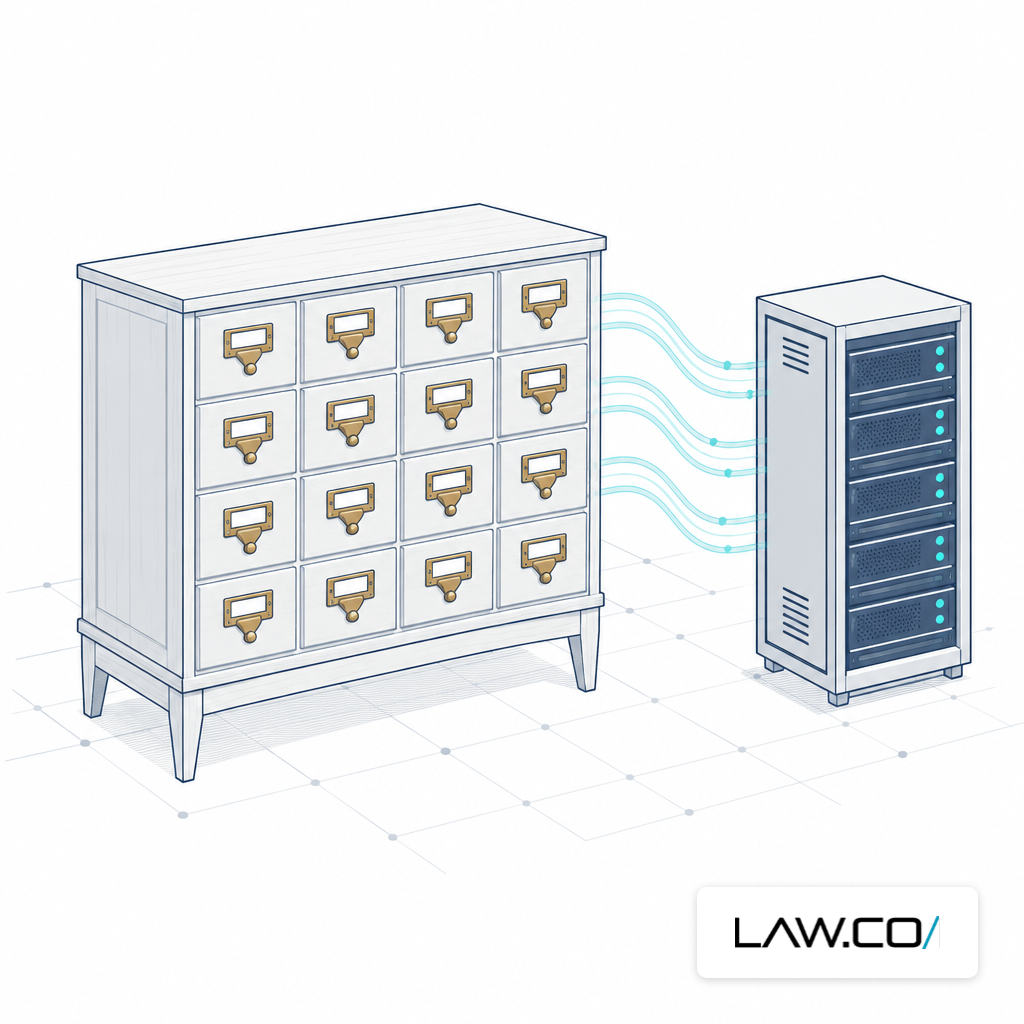
Orchestration is where single-shot prompts become multi-step work. A diligence memo, for example, routes through intake classification, document retrieval, extraction, redline generation, and reviewer assignment. Each step has its own model, its own data scope, and its own success criteria. Firms that build this layer with ad-hoc scripts hit a ceiling quickly; those that use graph-based or event-driven orchestration can add steps, swap models, and roll back failures without rewriting the pipeline. The firm's AI workflow orchestration practice and its guide to graph-based legal workflow orchestration describe the pattern in depth.
Agentic workflows extend this by letting the system plan, call tools, and recover from errors across longer horizons. The governance cost rises in proportion. Every agent step needs an auditable rationale, a bounded tool set, and a point at which an attorney can intercept. Techniques like deterministic rollout, policy-as-code, and context-aware arbitration between competing agents exist because free-roaming agents in a legal setting fail in ways that are hard to reconstruct after the fact.
Oversight, Governance, and the Audit Trail
Oversight is not a feature bolted on at the end; it is the layer that decides whether anything built above it can be used in client work. The NIST functions give the vocabulary, but the stack needs concrete artifacts: a system inventory, per-decision audit records, a human-in-the-loop checkpoint for any output that leaves the firm, and a corrective-action log for incidents. Without those four artifacts, there is nothing to show a client, an insurer, or a disciplinary board.
Regulatory ground is also moving. Colorado's original AI Act (SB 24-205) was repealed and replaced by SB 26-189, signed on May 14, 2026, which reshaped the state's automated-decision rules and delayed enforcement. Firms should assume the obligations of 2027 will not match the obligations of 2026, which argues for a legal AI governance posture that treats policies, prompts, and model cards as versioned artifacts rather than static documents. California's State Bar has published practical guidance on generative AI that most firms can adopt as a starting baseline.
| Function | Role in AI RMF | Stack layer it governs |
|---|---|---|
| Govern | Cross-cutting function infused throughout AI risk management | Policies, roles, and accountability across all layers |
| Map | Establishes context and identifies risks of the AI system | Workflow inventory and intended-use scoping |
| Measure | Analyzes, assesses, and tracks identified AI risks | Evaluation harness, retrieval scoring, model metrics |
| Manage | Prioritizes and acts on risks based on projected impact | Incident response, human-in-the-loop, corrective-action log |
Integrations and the Last Mile
A stack that lives in a separate browser tab does not get used. The integration layer wires the system into the DMS, matter management, time and billing, intake, and email, with permissions that mirror existing matter-level access. Intake is usually the cleanest first integration because it is bounded, measurable, and relatively low-stakes; client intake automation is where most firms see ROI inside a quarter. Contract workflows — review and drafting — follow once retrieval quality is proven.
Sequencing matters here. A workable order for a firm starting from scratch is: intake and conflicts first (bounded data, obvious wins), then internal knowledge search, then document review, then drafting, then litigation support. Pushing agentic drafting into production before the retrieval and oversight layers are solid is the common failure mode, and it produces the hallucination incidents that erode partner trust. The firm's work on avoiding AI hallucinations in case law search covers the specific controls that prevent most of them.
What Will Change the Decision Over the Next Year
The variable most likely to reshape stack decisions through 2027 is the regulatory one. Colorado's reversal signals that state-level AI rules will keep shifting under firms' feet, and jurisdictional routing — selecting models, retention policies, and oversight thresholds based on where the matter sits — will move from an advanced pattern to a baseline requirement. Clio's 2026 data already shows 86% adoption at mid-sized firms and 71% at solos, so the question is no longer whether to build but whether what has been built can be defended. Firms that treated governance as a cross-cutting function, not a final step, will be the ones with answers.

Samuel Edwards is a digital marketing strategist with 15+ years of experience helping professional-services firms — law firms among them — grow through SEO, content, and demand generation. He writes about how legal teams can adopt AI and modern marketing responsibly, without sacrificing the judgment and oversight their work demands.
Put a legal AI workflow to work — the right way.
Talk through the workflow you want to automate — contract review, drafting, or document intelligence — with a team that ships secure AI for law firms.